What to know
- Draw the dining, swimming, play and arrival zones before choosing a hedge.
- Place the screen where it interrupts the unwanted view, not automatically on the property line.
- Specify mature plant dimensions, available root space, irrigation and maintenance access.
- Use an approved built element where immediate enclosure is needed; planting takes time.
- Check the specific community rules before adding fixed structures or changing a boundary.
Quick answer: The best living screen for a Dubai villa is the one that divides the spaces you actually use without becoming a maintenance problem. Map the view from a dining seat, pool or entrance first; then choose plants by mature width, sun exposure, root space, irrigation and pruning access. A planted divider can define an outdoor room without enclosing the whole boundary.
Plan the outdoor rooms before selecting plants
A garden often needs several degrees of enclosure rather than one tall hedge. The route from the villa may need a glimpse of the pool; a dining area may need a quieter edge; a service route must remain accessible. Mark these functions on a measured plan and walk the site at the hours you expect to use each area. A daytime photograph from the living room does not tell you what a seated guest sees at night.
Decide whether you want to block a view, frame one or simply signal that one activity area has ended and another has begun. A low planted band can divide a lounge from a lawn while keeping supervision and long views. A taller, denser screen may be justified beside a dining terrace. Treat overlooking from an upper floor as a separate geometry problem: a plant at the boundary may have to become unreasonably tall before it hides that view. Our existing privacy-landscaping guide explains sightline mapping for that different problem.
Measure widths as well as heights. The footprint of a hedge includes its mature foliage and the space a gardener needs to clip or replace it. If the route is already narrow, a dense row may eventually reduce circulation or make pool equipment inaccessible. A thinner screen set closer to the activity area can do a better job than a broad perimeter hedge.
Choose a divider by what it needs to do
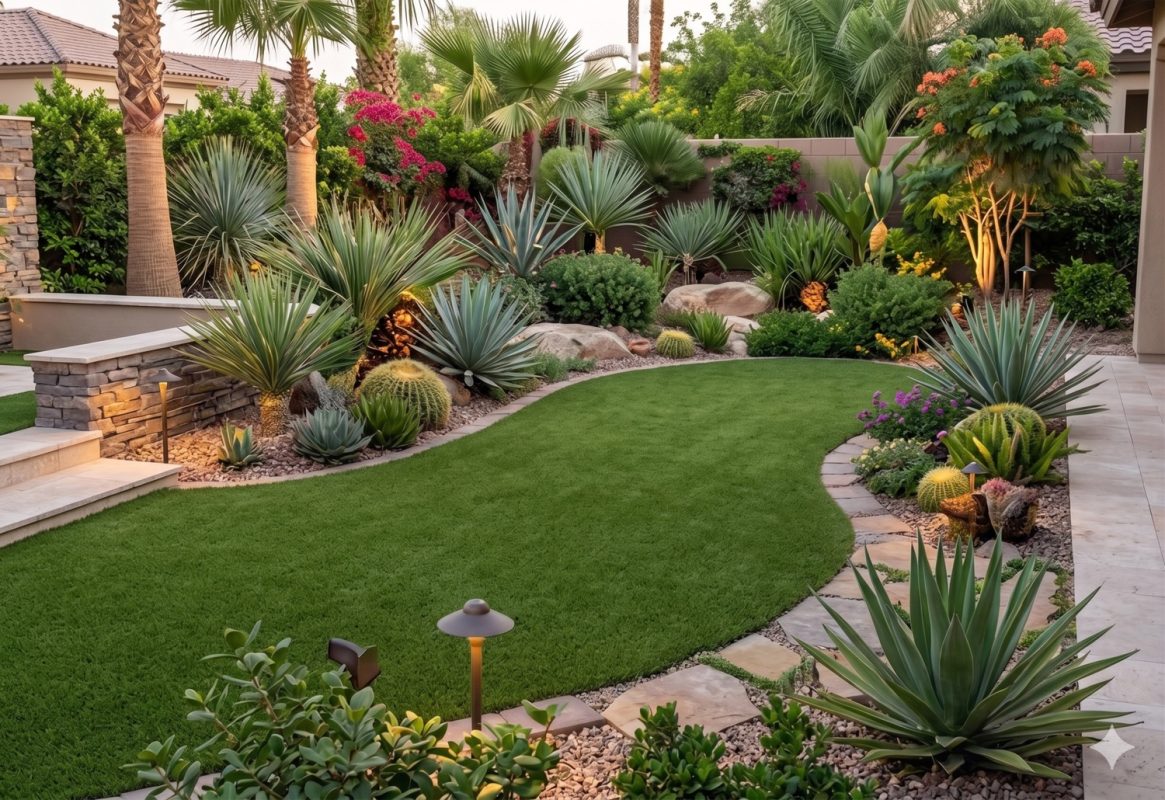
An evergreen row gives a consistent backdrop, but its regular rhythm can feel formal and a missing plant becomes obvious. A mixed border has more variation and can make replacement less conspicuous, although different mature sizes and watering needs complicate the design. A small tree with an underplanting layer may preserve useful open space beneath the canopy; a low shrub mass can guide movement without pretending to provide complete privacy. The Royal Horticultural Society’s screening guidance emphasizes ultimate height, spread, soil, exposure and maintenance rather than choosing a plant for rapid growth alone. Its UK plant list is not a Dubai suitability list.
There is also a time dimension. A temporary planter or a permitted screen might establish the boundary now, while planting softens it over the following seasons. Avoid presenting decorative planting as a child-safety pool barrier. If access control around the water is needed, ask a qualified designer to specify it as a separate safety element and check the applicable local requirements. The layout should show how the divider, supervision lines and circulation work together.
Think beyond foliage colour. Do you want filtered light, a solid-looking wall, seasonal flowers, a view through stems, or a clear top edge beneath a pergola? Can a visitor see the entrance? Does the plant shed leaves or fruit near the water? A divider that looks lush in a rendering may make a pool harder to maintain if it deposits material directly into the skimmer.
Test each candidate against the actual planting strip
Do not transfer the species list from a temperate-climate inspiration article directly into a Dubai villa. Assess direct and reflected sun, shaded hours, wind, soil texture, salinity, irrigation-water quality and the depth of usable soil. A narrow planter over a slab, a deep in-ground bed and a large container are different growing environments even when they occupy the same line on a plan. Dubai Municipality’s 2026 greenery-manual announcement describes climate-responsive planting and efficient irrigation for public landscapes; it is useful context, not an automatic specification or approval for a private plot.
Ask the designer or nursery for the proposed botanical name, supplied size, expected mature width in the intended conditions, root-space requirement and pruning response. The Dubai villa plant-selection guide is a useful starting point for exposure and poolside constraints, but a final species choice should follow a site survey. Names such as “fast-growing” or “low-maintenance” are not a substitute for a schedule of care.
Inspect underground and above-ground conflicts before planting. Keep access to valves, drain covers, inspection chambers and wall maintenance. Consider the clearance to windows, paving and pool shell, and what happens if a plant fails and must be lifted out. A removable planter can solve one conflict but introduces others: a container dries differently from ground soil and may need a more attentive irrigation plan.
How might the zones fit on a villa plan?
Imagine a hypothetical villa with a dining table beside the house, a pool in the centre and a children’s lawn beyond. The owner wants a calmer dining zone but still needs to see the pool. A tall continuous hedge between dining and water would defeat that supervision goal. A lower planting band, with a narrower upright element at the one exposed corner, could define the terrace without closing the entire view. The exact heights and species would be decided only after measuring the sightline and checking the site.
Now place the service route and pool plant on the same drawing. If maintenance staff must pass behind the proposed border, keep a continuous access strip. If the divider is near steps, review lighting and trip edges. If it sits along a shared boundary, identify the relevant community document before committing to a fixed trellis or screen. This simple exercise often changes a proposed single hedge into a set of smaller, more useful elements.
Use a sample board and plan rather than a plant name alone. Show the divider in elevation from the seated position and from the main approach. A line of nursery specimens may look dense at installation yet become too broad later; conversely a sparse young planting may be acceptable if the owner understands the establishment period. Label what is immediate and what is expected to develop over time, without promising a precise growth date.
Plan for establishment, irrigation and replacement
A living screen is a maintenance commitment, not a one-time purchase. Newly planted trees and shrubs need monitoring while their roots establish. The RHS planting and aftercare guide notes that the root zone can be dry even when the soil surface appears moist. Its UK seasonal advice should not be copied as a Dubai watering timetable; a local irrigation schedule must reflect the actual species, soil, weather and water source.
Specify how each zone is watered and how a failed plant will be replaced. Mixing very different water needs on one valve can force a compromise that suits neither. Leave room for checking emitters and for pruning the side facing a wall or neighbour. Agree whether the desired final form is clipped or informal; the latter is not maintenance-free, and the former needs dependable access and a realistic service interval.
Check the divider after its first periods of strong sun and wind. Look for leaning supports, uneven irrigation, stressed leaves and branches growing into a route. Adjust the plan while plants are still small rather than repeatedly cutting back a species that was wrong for the available space. Keep a record of supplied plant identities and irrigation zones for the owner and future gardener.
What belongs in a useful design brief?
Give the designer a marked plan, photographs from the seats and windows, the hours each zone is used, the sightlines to retain, and any access or supervision requirements. Ask for a planting schedule with mature dimensions, a section through the proposed screen, an irrigation diagram, soil and root-space detail, a maintenance plan and a list of approval-dependent built elements. For a coastal or exposed plot, document salt and wind exposure rather than assuming an inland palette will perform the same way.
Green Earth can coordinate this decision with villa landscape design and construction, so the screen works with circulation, irrigation and the wider outdoor room. In Dubai communities such as Arabian Ranches, Jumeirah and The Meadows, the site and community rules still need individual review; these names describe possible project context, not a promise that one standard screen fits every villa. Share a plot plan and the view you want to change to start with a specific brief.
Questions about this topic
What is the key takeaway from Living Screens for Dubai Villa Gardens: Divide Outdoor Rooms with Plants?
Draw the dining, swimming, play and arrival zones before choosing a hedge. Place the screen where it interrupts the unwanted view, not automatically on the property line.
How might the zones fit on a villa plan?
Imagine a hypothetical villa with a dining table beside the house, a pool in the centre and a children's lawn beyond. The owner wants a calmer dining zone but still needs to see the pool. A tall continuous hedge between dining and water would defeat that supervision goal. A lower planting band, with a narrower upright element at the one exposed corner,...
What belongs in a useful design brief?
Give the designer a marked plan, photographs from the seats and windows, the hours each zone is used, the sightlines to retain, and any access or supervision requirements. Ask for a planting schedule with mature dimensions, a section through the proposed screen, an irrigation diagram, soil and root-space detail, a maintenance plan and a list of approval-dependent built elements. For a coastal...
How often should a Dubai villa pool be maintained?
The schedule depends on pool use, water temperature, dust exposure, equipment, and surrounding landscaping. Dubai conditions usually require frequent testing, cleaning, filtration checks, and chemical adjustment rather than occasional reactive visits.