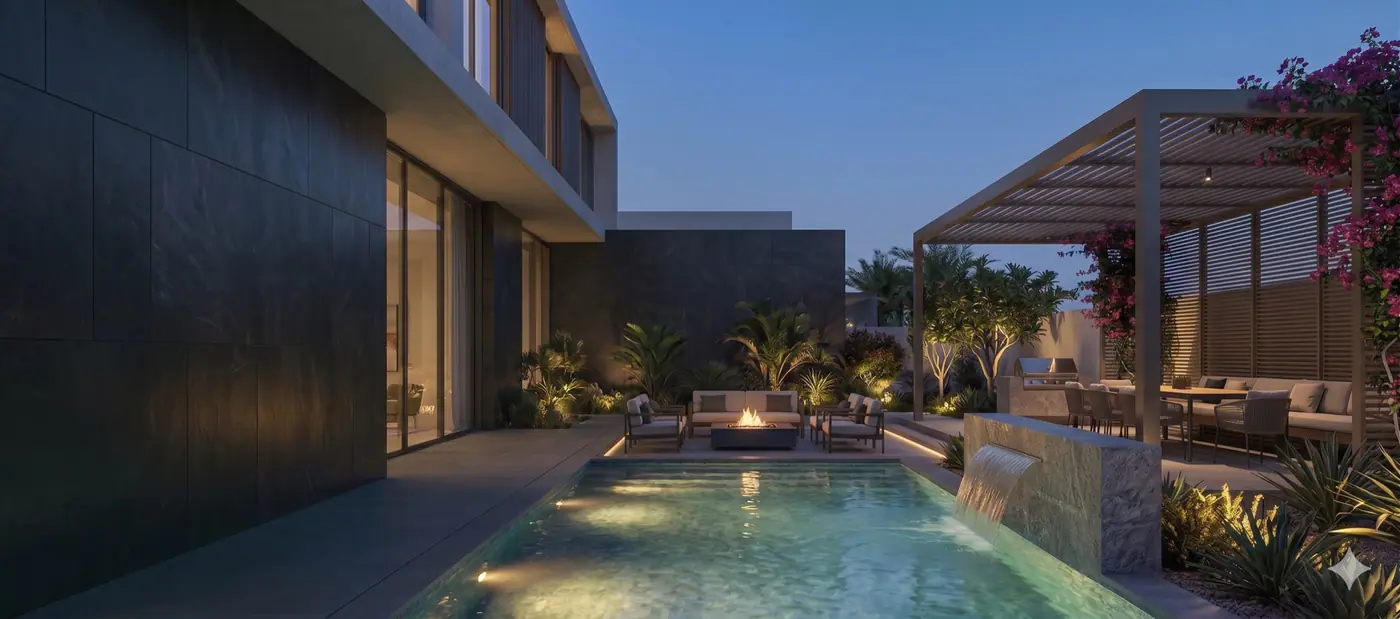
What to know
- Keep useful existing landscape elements where a survey supports it.
- Size lawn and planting for real use, then group plants by water need.
- Design irrigation around the root zone, with access for inspection.
- Use shade and durable, replaceable surfaces to support outdoor use.
- Record baseline conditions and review water and plant performance after installation.
Quick answer: Sustainable landscaping in Dubai is a set of practical choices, not a look. Start by reducing unnecessary irrigation demand, preserving useful shade, choosing plants and materials that suit the plot, and making the finished garden repairable. Measure the result by how the landscape operates after handover, including water use and replacement needs, rather than by how many “eco” products appear on a mood board.
What should “sustainable” mean on a Dubai villa plot?
Ask what the household needs from the garden: a place to sit, a play area, privacy, a pool route or planting for enjoyment. Then identify the resources needed to keep those functions working. A large irrigated lawn may be justified if it is the family’s main activity space; a narrow decorative lawn that nobody uses deserves scrutiny. A durable paved court may reduce irrigation but increase heat and runoff if it removes all shade and permeable ground. The right answer requires a site plan, not an absolute rule for every villa.
Before demolition, assess existing trees, paving and irrigation. A healthy mature tree with sufficient root space may be more useful than a newly installed shade feature. A serviceable surface might be retained or repaired rather than replaced. Document what is worth keeping, what fails and why. This avoids discarding materials and living structure without a clear benefit. The site-survey-to-design guide explains the information a measured survey should capture.
Dubai Municipality’s 2026 greenery manual announcement describes water-efficient and climate-responsive landscape planning for public spaces. A private villa does not receive approval from that announcement, but its central questions still apply: which plants suit the site, how is water delivered, and how will the place be managed over time? Write those questions into the owner’s brief before comparing styles or products.
How can a villa reduce avoidable water demand?
Water-efficient landscaping begins with area and plant choice. Put lawn only where it serves a use, give beds enough soil volume, and group plants with compatible water and sun needs. A controller can help manage zones, but it cannot correct a spray head that wets paving or a tree receiving the same short cycle as shallow groundcover. The US EPA’s water-smart landscaping guidance links plant choice, soil condition, climate and maintenance. Its example water budgets are not Dubai prescriptions; the method of checking demand is valuable.
Ask for an irrigation diagram showing each valve, delivery type and area served. Review pressure, coverage, filtration and a way to isolate a fault. Specify who can adjust schedules, how a leak is noticed and how the system is tested before handover. For existing gardens, fix leaks and poor distribution before assuming that all plants need more water. DEWA’s irrigation advice provides local conservation context, including attention to when water is applied; a technician should set timing for the specific site, soil, plants and weather.
Consider where water comes from and where it goes. Irrigation overspray, pool splash and roof drainage can all affect a planter or paving edge. Make the route of rain and cleaning water visible on drawings. Avoid promising a particular percentage of water saving without a measured baseline and comparable operating period. If water use is a priority, ask how it will be monitored and what parts of the bill can realistically be attributed to the garden.
Choose plants and soil as one system
A plant advertised as drought-tolerant may still fail if it sits in an undersized planter, compacted soil or a zone with the wrong irrigation pattern. Record exposure, reflected heat, wind, drainage and available root space. Then choose species for those conditions, including mature size and maintenance needs. The Dubai villa plant guide helps organize options, but the final plant schedule should follow the actual plot. A coastal villa and a sheltered inland courtyard may have different stresses.
Soil deserves a test where plants have repeatedly struggled. Adding fertilizer or more water without identifying compaction, drainage or salinity may make the problem worse. Keep topsoil, planting medium and mulch specifications separate; each has a different job. A mulch layer can protect a root zone, but it must be applied and maintained appropriately for the species and irrigation method. Our soil investigation article explains why repeated plant loss should be diagnosed before replanting.
Think about replacement as well as installation. A plant palette that depends on one hard-to-source specimen may be difficult to maintain. Ask for botanical names and acceptable substitutions so a failed plant does not trigger a visually mismatched replacement. Use diverse planting where it helps resilience and the design; avoid claiming that every native or adaptive plant automatically needs no irrigation. Establishment care remains necessary, and performance depends on placement and management.
Make shade, comfort and drainage part of the same plan
Outdoor comfort is one reason for a villa landscape, so locate shade where people will actually sit or move. A tree may shade a route at one hour and miss the dining area entirely at another. A pergola may need a roof or screen detail to work for the intended use; it also changes planting light, drainage and possibly community approval. Study the sun path with a plan and eye-level views. Our pergola placement guide turns that into a practical review.
Surfaces affect how the garden feels and how it handles water. A huge dark paved court may be simple to wash but uncomfortable to touch or walk on in sun. Dense hardscape can also move rainwater toward doors and planters if levels are wrong. Combine surfaces according to function, access and exposure rather than treating “more green” or “more paving” as inherently sustainable. Show falls, drains and overflow routes on the technical drawings. The garden drainage guide covers how to examine those routes before construction.
Consider the time scale. A new tree may take time to provide useful canopy, while a built structure can shade immediately but may have greater material and maintenance costs. A hypothetical design might preserve an existing tree over a seating edge and add a modest permitted shade element where the tree cannot reach. That is a decision framework, not a guarantee that any particular combination suits every plot. Measure the actual site and check structural and community constraints first.
Compare durability, repair and sourcing, not labels alone
Material sustainability is often reduced to a product adjective. Ask instead how a surface will be installed, cleaned, repaired and replaced. A locally available standard-size paver that can be lifted individually may be easier to maintain than an exotic finish that requires replacing a whole section after damage. Look at edge details, drainage, sub-base and available spares. Even a durable material performs poorly if the installation detail lets it move, stain or trap water.
Request samples under actual daylight and test the proposed cleaning method. Examine a wet sample near the pool, a shaded sample beside the house and a sun-exposed one along the main route. Confirm the finish’s intended use and any specialist maintenance. Do not claim a carbon footprint advantage without product-level data and a defined comparison. If embodied impact matters to the owner, ask suppliers for declarations and compare like-for-like service lives rather than relying on marketing language.
Think about lighting and equipment as part of the material plan. Accessible fixtures and replaceable components support long-term repair. Pool covers, pumps and irrigation controllers need their own operational and service decisions; an efficient product cannot compensate for poor sizing or neglected maintenance. Keep design drawings and equipment schedules together so the garden can be adjusted instead of demolished when a component eventually fails.
How can an owner tell if the result is working?
At handover, keep a plant schedule, irrigation map, equipment manuals and a maintenance plan. Photograph the original conditions and record any baseline water data available. After installation, inspect plant health, irrigation coverage, leaks, drainage and comfort at the hours the space is used. Ask whether the garden is serving the activities named in the brief. Sustainability is demonstrated by continued fit and manageable operation, not merely by installing particular materials once.
Set an early review while plants establish and another after a demanding season. If the owner sees stress, diagnose its cause before replacing the plant or increasing all water schedules. If a paved area feels too exposed, inspect shade geometry rather than purchasing a decorative object that blocks circulation. The pool and garden handover checklist helps keep the evidence and responsibilities organized. Make adjustments traceable so future gardeners know what changed.
Green Earth can combine villa landscape planning and construction with irrigation, planting and outdoor-living decisions. The advice applies to Dubai and other UAE projects only after checking local plot conditions and community requirements. Share your site plan and the resource or maintenance problem you want to improve for a focused design discussion.
Questions about this topic
What is the key takeaway from Sustainable Landscaping in Dubai: Water, Shade and Materials That Matter?
Keep useful existing landscape elements where a survey supports it. Size lawn and planting for real use, then group plants by water need.
What should “sustainable” mean on a Dubai villa plot?
Ask what the household needs from the garden: a place to sit, a play area, privacy, a pool route or planting for enjoyment. Then identify the resources needed to keep those functions working. A large irrigated lawn may be justified if it is the family's main activity space; a narrow decorative lawn that nobody uses deserves scrutiny. A durable paved court may...
How can a villa reduce avoidable water demand?
Water-efficient landscaping begins with area and plant choice. Put lawn only where it serves a use, give beds enough soil volume, and group plants with compatible water and sun needs. A controller can help manage zones, but it cannot correct a spray head that wets paving or a tree receiving the same short cycle as shallow groundcover. The US EPA's water-smart landscaping...
How can an owner tell if the result is working?
At handover, keep a plant schedule, irrigation map, equipment manuals and a maintenance plan. Photograph the original conditions and record any baseline water data available. After installation, inspect plant health, irrigation coverage, leaks, drainage and comfort at the hours the space is used. Ask whether the garden is serving the activities named in the brief. Sustainability is demonstrated by continued fit and...